Siberia
Doctor ZhivagoSiberia, as remembered by Tania, is the setting of a childhood shaped by separation, political danger, and journeys across immense distances. Her account links the region’s railway geography to her mother’s fear and to the circumstances that brought a signal woman into their lives.
A remembered geography
Tania locates the events she recounts beyond Krushitsy, on the far side of Siberia and Cossack country, near the Chinese border. The place is introduced not through a general landscape description but through a sequence of distances and stations: Nizovaia, Nagornaia, and Samsonov Pass. Nagornaia, she explains, was three stations from the town.
This geography comes to the reader through Tania’s recollection rather than an impersonal account. She reconstructs how her mother might have known Marfa, a signal woman at Nagornaia: Marfa may have come into town to sell milk and vegetables. Tania presents this as a possibility she has only now begun to understand, making the railway map part of her effort to piece together a family history.
Flight and separation
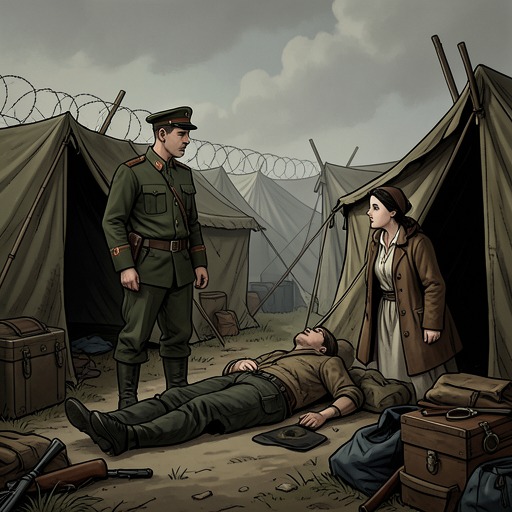
Tania says that when the Reds advanced on the Whites’ chief town, the minister Komarov put her mother and other families on a special train and ordered them taken away. Her mother was frightened and did not dare move without him. In Tania’s account, the train thus becomes an instrument of displacement, carrying families away as the political front approached.
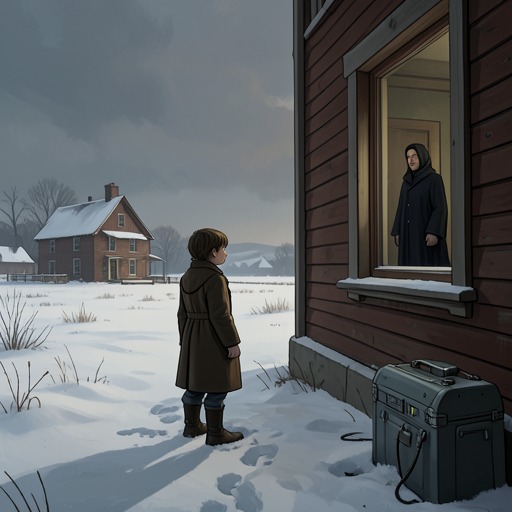
The danger was also bound up with Tania’s concealed existence. She says Komarov did not know she existed: her mother had given birth to her after a long separation from him and feared that someone might reveal the child’s presence. Tania remembers that Komarov hated children and would shout that they brought filth and worry into the house. Her Siberian story is therefore not merely a tale of wartime movement; it is also a recollection of a child whose place in the family had to remain hidden.
The journey to Nagornaia
As the Reds began to approach the town, Tania’s mother sent for Marfa at Nagornaia Station. The account’s step-by-step naming of the stations gives the request a practical measure: Marfa was not nearby, but several stops away along the railway. Tania’s conjecture that Marfa had previously sold produce in town offers a possible reason her mother knew to seek her help.
Years later, Tania tells this story to explain what she knows about her parentage and early life, while acknowledging that some parts reach her as uncertain reports or reconstructed memories. Siberia consequently appears as a space where family connections, political upheaval, and railway travel intersect—and where Tania must assemble her history from fragments rather than from a complete account.